Learn · Pricing
Index price vs last price: which one should decide your liquidation?
Perpetual futures platforms show several prices for the same contract. The one that triggers your stop-loss and liquidation matters more than the one on the chart. Here is what each price is and why a median index is the fairer referee.
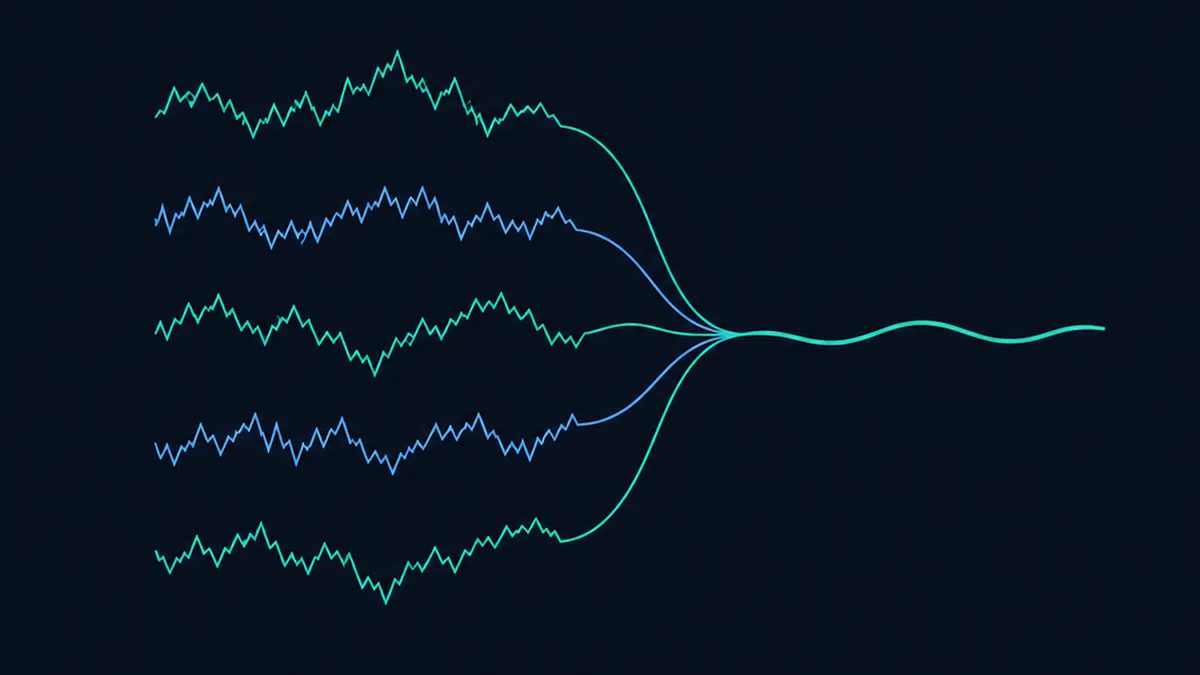
Three prices for one contract
| Price | What it is | Used for | Can one trade move it? |
|---|---|---|---|
| Last price | The most recent trade on one venue | Charts, order-book trading | Yes |
| Index price | A combined spot price from several exchanges | Reference for fair value | Hardly |
| Mark price | The value used for P&L, liquidations and triggers | Margin, liquidation, stops | Should not |
On a well-designed perpetual platform, the mark price is derived from the index, sometimes with a small adjustment for the perp's premium. On a private desk, as described in What is a perpetual futures trading desk, there is no order book of its own, so the index is the natural reference for everything: fills, valuation and liquidation.
Why last price is a bad referee
A "wick" is a brief price spike on one venue, often caused by a large market order hitting a thin order book, a liquidation cascade or a technical fault. It can last seconds and reverse completely. If liquidations follow the last price of that venue, positions everywhere on it can be closed at a price that the wider market never traded at.
Wicks are not only accidents. Anyone who knows that a platform liquidates on one thin market has a reason to push that market for a moment. Using a broad index removes the reward.
Median vs average
Suppose five exchanges quote BTC at 50,000, 50,010, 49,990, 50,005 and, during a wick, 45,000.
| Method | Result | Effect of the wick |
|---|---|---|
| Single venue (the one with the wick) | 45,000 | −10% |
| Average of five | 49,001 | about −2% |
| Median of five | 50,000 | none |
The median ignores the most extreme values entirely, as long as fewer than half the sources are wrong at the same time. That is why it is the better choice when the goal is "what is the price everywhere else?" rather than "what was the last trade somewhere?"
When sources fail or disagree
- A source goes offline: it is removed from the index until it recovers. The median of the rest continues.
- Too few sources remain: the index is marked unhealthy and new positions pause.
- Sources diverge beyond a threshold: something unusual is happening, so new positions pause. Existing positions are liquidated or capped out only on a valid index.
- Every decision is recorded: the index value, each source quote and the timestamp are stored with each fill and trigger, so a dispute can be settled with evidence rather than opinion.
Pausing new positions in a disorderly market protects both sides. Combined with reserved payouts, described in How capped-payout perps keep a desk solvent, it means a desk cannot be forced into a deficit by a bad price, and a trader cannot be liquidated by one.
Why this matters more on a private desk
On an exchange, the venue and its traders have different interests from any one trader, but none of them sets the price alone. On a private desk, the desk is the counterparty. If the desk also chose the price, it would be setting the score of a game it is playing. That is the oldest complaint about B-book brokers, and the only lasting fix is to take pricing out of the desk's hands entirely.
How PerpRelay prices
- Index: median of spot prices from several large exchanges, such as Binance, OKX, Bybit and Coinbase.
- Fills: index plus the desk's published spread. Desks cannot edit fills.
- Liquidation, stop-loss, take-profit and cap triggers: on the index, never on one venue.
- Health checks: automatic pause of new positions on outages or divergence.
- Evidence: index and source quotes stored with every fill, exportable by desk and trader.
The full set of rules is on the safety page, and the order flow is on How it works. Traders can see what this means for them on For traders.