Learn · Desk basics
What is a perpetual futures trading desk?
A private desk lets a group of traders open perpetual futures positions against one counterparty they know, instead of an anonymous exchange order book. Here is how that works, why it exists, and where it can go wrong.
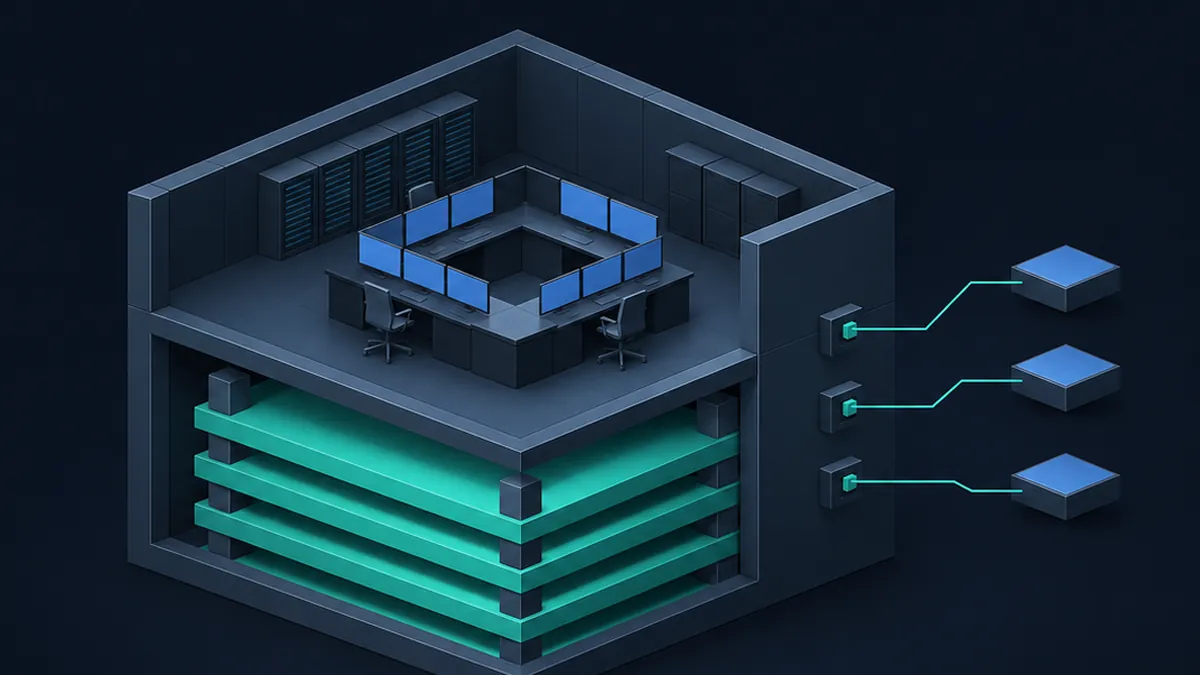
Perpetual futures in one minute
A perpetual futures contract, or "perp", is a leveraged position on the price of an asset such as BTC or ETH. Unlike a traditional futures contract, it never expires. You post margin, choose leverage, and go long (you gain if price rises) or short (you gain if price falls).
- Position size = margin × leverage. 100 USDT at 10× controls a 1,000 USDT position.
- Liquidation: if losses use up most of your margin, the position is closed. At 10× that happens after a move of roughly 10% against you.
- Funding: every few hours, longs pay shorts or shorts pay longs, depending on which side is more crowded. This keeps the perp price close to the spot price.
- Mark price: the reference used to value positions and trigger liquidations. Good venues use an index of several exchanges rather than their own last trade; see Index price vs last price.
What makes something a "desk"
On an exchange, your counterparty is whoever happened to take the other side in the order book. On a desk, there is one known counterparty: the desk itself. The desk quotes you a price (usually the exchange price plus a spread), and when you open a long, the desk is effectively short to you.
| Exchange | Private desk | |
|---|---|---|
| Who takes the other side | Other traders in the order book | The desk's own capital |
| Where the price comes from | The venue's own order book | A reference price plus the desk's spread |
| Who can join | Anyone eligible who signs up | Usually by invitation |
| Typical size | Millions of users | Tens to thousands of clients |
| What you rely on | The venue's solvency and rules | The desk's ability and willingness to pay |
This "desk takes the other side" structure is what the brokerage world calls a B-book. It has close cousins, compared side by side in B-book vs A-book vs the desk model.
Who runs desks, and why
- Trading communities and signal groups. Members want to act on the group's ideas in one place, with familiar people and their own rules.
- Introducing brokers. Instead of earning a small rebate for sending clients to an exchange, they earn the spread and fees directly.
- Regional and OTC desks. They serve clients who prefer a local relationship, a local language or local payment methods, where permitted.
- Small funds and prop teams. They choose to take the other side of retail flow in controlled size.
Clients choose desks for the relationship, for simpler onboarding, and sometimes for terms an exchange does not offer. What they give up is the protection of a large venue's rules and capital, which is why the questions further down matter. PerpRelay's view of each side is on the desk owner and trader pages.
How a desk earns and loses
| Source | Direction | Notes |
|---|---|---|
| Spread | Earns on every trade | Difference between fill price and reference price |
| Fees | Earns on every trade | Charged on open and close |
| Funding | Usually earns | Clients tend to crowd one side and pay funding to the desk |
| Client P&L | Either way | The desk gains what clients lose and pays what clients win |
| Hedging | Reduces variance | The desk offsets net exposure at an exchange, at a cost |
Across many clients and long periods, spread and fees usually outweigh what clients win, which is why desks exist. But client positions are not independent: clients often buy the same breakout at the same time. A single strong trend can produce a period where nearly every client wins at once.
The one way desks fail
Most desk failures follow the same script. Clients pile into one direction with leverage. Price moves hard that way. Client profits grow faster than the desk's free capital. At that point the desk has three options, all bad: pay some clients and not others, delay or block withdrawals, or close with a deficit that someone else covers.
Insurance funds, credit lines and "we will cover it" promises all try to fill that gap after it opens. A different approach is to make the gap impossible: cap each position's payout and reserve it before the trade fills. That is the subject of How capped-payout perps keep a desk solvent.
Ten questions to ask any desk
- Who is the counterparty to my trades, by name?
- What is the most the desk could owe all clients right now, and is that amount set aside?
- Where does the price come from? Can anyone at the desk change it?
- What happens to my position if the price feed fails?
- Can I see a record of the reference price at the moment of each fill?
- Who holds my margin, and can the desk use it for anything else?
- Can the desk delay or refuse a withdrawal? Under what written rule?
- Does anyone at the desk trade against clients from a separate account?
- What are the spread, fees and funding rules, in writing?
- Is the desk permitted to serve clients where I live?
A desk that answers these clearly, with evidence, is worth considering. A desk that answers "trust us" is asking you to carry risks you cannot measure. Our own answers are on the safety and architecture page and in the FAQ.
How PerpRelay approaches it
PerpRelay is software that desk owners use to run a desk. The desk owner is the counterparty; PerpRelay never is. Every position's payout is capped at 5× margin and reserved from the desk's funds before it fills, prices come from a multi-exchange median, and every desk publishes proof of reserve. The platform is in a paper-trading stage today; real-money desks follow the conditions on the roadmap. See How it works, or apply as a founding desk.